Dynamic Line Ratings
Accurate real-time and forecasted transmission capacity at every span across networks
Our Dynamic Line Ratings
Built on years of field sensor data, our industry-leading methodology uses advanced, computational fluid dynamics (“CFD”) modeling with digital twins created from utility-provided data. Our CFD-powered approach accounts for all localized terrain, vegetation, and structures to build hyper-accurate wind models to 30m resolution


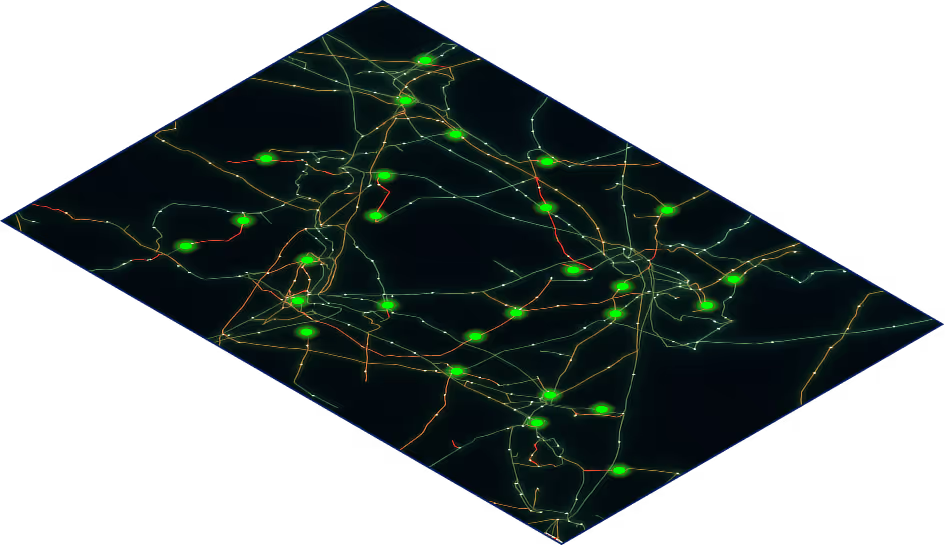


Achieve Full Network Visibility
We rapidly deliver operational-grade dynamic line ratings across the entirety of transmission networks. Our solution can be further enhanced by strategically deployed sensors to improve ratings accuracy and deliver maximum visibility where and when needed most
Network-Wide Dynamic Line Ratings
Rapid delivery of full network visibility, unlocking value across operations and planning
Maximum Visibility for Critical Lines
Sensor deployments enhance ratings accuracy through direct, span-level measurements and deliver situational awareness with sag measurements
Best-In-Class, End-to-End Support
From design through deployment, our industry-leading service offering includes 24/7 customer support with regular reporting and insights, NERC-CIP compliant EMS integration, and support with regulatory approvals
What You Get With Dynamic Line Ratings


Discover How Dynamic Line Ratings (DLR) Helped AES Safely Optimize Capacity and Strengthen Resilience

“This is something we're hearing from our customers - how fast can you deliver this capacity? Reconducturing is at least 2 years in a very positive scenario, whereas... we got DLR deployed in a month."
AJ Hall

National Grid UK : Alleviating Congestion of Critical
Circuits with Dynamic Line Ratings
National Grid owns and operates the transmission network in England and Wales, with 7,200 kilometers (4,474 miles) of overhead line. A lack of transmission capacity & flexibility across the UK has been causing offshore wind curtailments, interconnection issues, and challenges delivering power to load pockets in the south, all contributing to congestion costs to the operator and consumers.
“Integrating grid-enhancing technologies such as LineVision’s is a crucial part of National Grid’s work to increase the capacity of our network to meet increased demand. Innovative projects such as this will boost the capacity of our existing infrastructure and help increase the network’s capacity for renewable power, delivering lower costs for consumers whilst continuing to maintain world-class reliability.”
Mark Lissimore

Connect with our grid modernization team today
FAQ's
The use of DLR in operations provides grid operators with more visibility into their system and more control over their grid. Seamlessly integrated into the control room EMS, they optimize transmission by identifying the true thermal limits of overhead conductors. Grid operators can use these ratings in real-time and day-ahead markets and operations.
When DLR technology is used in operations, historical line ratings can be analyzed to create probabilistic line ratings which can be available on a seasonal, monthly, or more granular level to inform the planning process. The additional data regarding the hourly / sub-hourly thermal rating that comes from DLR can help maximize the efficiency of transmission planning.
Most utilities that use our DLR experience average capacity gains upwards of 30%, with some reaching the triple digits on certain lines. The capacity change will vary according to a large set of variables, including region, conductor/tower type, current rating methodology, utility risk profile, and climate. During the sales process, we conduct rigorous profiling studies to analyze target lines and scope out a project with maximized benefit.
DLR differs from AAR by using real-time weather and wind data, resulting in more accurate ratings. DLR provides enhanced operational awareness and risk reduction by avoiding overstated capacity and detecting potential anomalies. Additionally, sensor-validated DLR offers increased accuracy and deep learning capabilities alongside the use of software-only models.
LineVision’s line rating systems are designed to fully comply with NERC-CIP requirements if deemed in scope by the utility.
We have successfully achieved ISO 27001:2022 certification for our operationalized LineRate solution, demonstrating the comprehensive measures we have implemented to ensure the confidentiality, integrity, and availability of our customers' data. We have undergone rigorous third party audits and assessments, which are updated annually, affirming that our information security controls meet the stringent requirements of the standard.
DLR can be deployed on new transmission projects, existing infrastructure, or to support the outages required for rebuilds and reconductoring. DLR is 5 to 7% of the cost of traditional transmission upgrades and can be installed in months without the need for outages.
Our scoping process identifies the most limiting spans along a line that require field monitoring. A typical installation will monitor a full range of sites with differing angles of incidence to wind, topography/sheltering, conductor type, and maximum operating temperature.
Our ratings model is continually trained and improved using sensor-based data as feedback. This training improves accuracy and confidence in delivered ratings. The model incorporates statistical distributions to deliver confidence intervals that provide a comprehensive rating product.
Hardware requirements are dependent on project scope and complexity; however, one sensor per 2 to 3 miles is a reasonable estimate.
We can provide documentation of DLR methodology to support FAC-008 documentation requirements.
Yes, our software integrates non-conductor facility limitations, allowing complete facility ratings management including elements such as transformers, switches, wave traps, etc. as potential limiting factors alongside the conductor's Dynamic Line Ratings.