Transmission lines, the arteries of the power grid, need more room to breathe
Why Utilities Are Looking Beyond Individual Lines and Toward Network-Wide DLR
Electric utilities are under increasing pressure to do more with their existing transmission infrastructure. Load growth from data centers, electrification, advanced manufacturing, and other large industrial customers is driving demand higher than many utilities have seen in decades. At the same time, renewable energy development continues to accelerate, reliability expectations remain high, and building new transmission infrastructure can take years to permit and construct.
As a result, finding additional capacity within the existing grid has become a growing priority. Dynamic Line Ratings (DLR) have long been used to address transmission constraints on individual lines, helping operators understand how much power a conductor can safely carry under actual weather conditions rather than relying solely on conservative static ratings. But as grid challenges become more widespread, utilities need to utilize every tool available to grow networks while maintaining affordable rates.
As transmission challenges become more widespread, the focus is expanding beyond individual constrained lines. Visibility across larger portions of the network can provide a clearer picture of system conditions, available capacity, and where opportunities exist to improve performance across the grid.
From Static Ratings to Real-Time Visibility
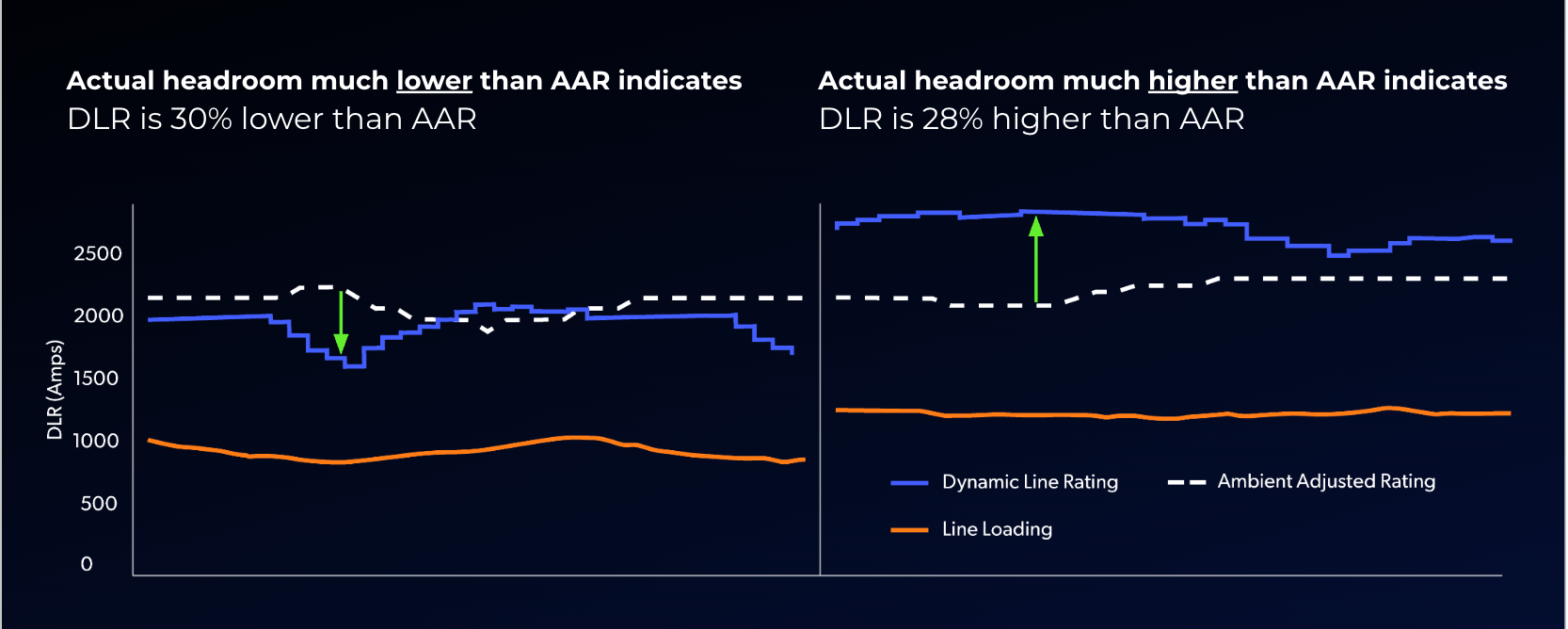
Traditional transmission ratings are intentionally designed to be conservative, since assumed wind speed and temperatures will vary significantly from actual conditions. Dynamic Line Ratings provide a more accurate picture by continuously incorporating real-time environmental conditions such as wind speed, ambient temperature, solar heating, and conductor behavior. Because transmission lines are often cooled by wind and operate under conditions that differ significantly from worst-case assumptions, actual capacity is frequently higher than the static rating suggests.
Following FERC Order 881, utilities are now required to use Ambient Adjusted Ratings (AAR), which update transmission limits based on seasonal and forecasted temperatures instead of fixed assumptions. AAR is an improvement from static ratings, but it still doesn’t capture key real-time factors like wind, solar heating, or localized weather, which can significantly affect line capacity. Because it relies on forecasted rather than actual operating conditions, AAR can both overestimate and underestimate available capacity. It also does not account for factors such as vegetation clearance, making it less effective for real-time operational decision-making. As a result, it is useful for compliance and baseline planning, but limited for real-time operations.
DLR allows operators to see that available capacity in real time, creating opportunities to move more power across existing infrastructure while maintaining safety and reliability.
Optimizing Capacity Across the Entire Network
One of the biggest shifts occurring in the industry is the recognition that transmission constraints rarely exist in isolation.
When congestion appears on one line, the impacts often ripple across neighboring circuits and interconnected portions of the network. Understanding the capability of a single transmission asset is valuable, but understanding the available capacity across an entire region of the system can provide even greater operational benefits.
A network-wide DLR deployment provides a broader view of how transmission capacity changes across the system. Rather than focusing on a handful of constrained assets, it enables visibility into available capacity across multiple corridors and supports more informed operational decision-making. This system-level perspective can reveal underutilized capacity, improve the use of existing infrastructure, and provide a better understanding of overall network performance without requiring immediate physical upgrades.
Preparing for Uncertain Load Growth
The rapid expansion of data centers, electrification initiatives, and new industrial facilities is creating demand across entire service territories. In many cases, utilities are receiving requests for large new loads in locations that were not previously expected to experience significant growth. Companies building data centers are also investigating multiple territories at a time to find the best deal, or to circumvent interconnection entirely through colocation. Having visibility into transmission capacity across a broad portion of the network gives utilities agility to address load and attract more economic development. Rather than evaluating capacity based solely on static assumptions, planners and operators can better understand where additional load may be accommodated and how future growth could impact the system.
Supporting Renewable Integration
A new wind or solar facility can affect power flows across multiple transmission paths, creating constraints far from the point where the project interconnects. As renewable penetration increases, utilities need greater awareness of available transmission capacity throughout their systems. Network-wide DLR can help provide that visibility and accelerate the process.
By understanding actual transmission capacity across multiple corridors, operators can better manage changing power flows, reduce renewable curtailment, and maximize the use of existing transmission infrastructure. This can help utilities integrate more renewable generation without waiting for large-scale transmission expansion projects to be completed.
Strengthening Reliability and Resilience
Reliability remains one of the most important responsibilities utilities face, particularly as extreme weather events become more frequent and severe.
Heat waves, cold snaps, wildfires, storms, and other system disruptions can quickly change transmission operating conditions. During these events, operators need accurate information to make confident decisions.
A broader DLR deployment gives utilities real-time visibility into how transmission capacity is changing across the network. This enhanced situational awareness can support contingency planning, emergency operations, and day-to-day reliability management.
When conditions are changing rapidly, having access to actual system capability can be just as important as having access to system demand.
Making Better Investment Decisions
Utilities are also facing difficult decisions about where and when to invest in new transmission infrastructure.
Transmission upgrades require significant capital, and planning decisions are often based on studies that rely heavily on static assumptions. While those assumptions are necessary for planning purposes, they do not always reflect how the system operates in practice.
Network-wide DLR can provide planners with a more complete understanding of how transmission assets are actually performing over time. This information can help identify true bottlenecks, improve planning studies, prioritize investments, and potentially defer upgrades that may not be needed as soon as previously thought.
In this way, DLR becomes more than an operational technology; it becomes a planning tool that helps utilities make smarter long-term investment decisions.
The Evolution of DLR
For many years, DLR was primarily used to address specific transmission constraints and bottlenecks. While those applications remain important, there is growing interest in using DLR to provide visibility across larger portions of the transmission network.
As electricity demand increases and transmission systems face greater operational pressure, understanding actual system capacity becomes increasingly valuable. A network-wide approach to DLR provides a more complete picture of transmission performance, helping identify available capacity, improve situational awareness, and support operational and planning decisions.
The value of DLR is not limited to increasing the rating of individual lines. Broader benefit comes from providing the visibility needed to better understand and manage the transmission network as a whole.
LINKEDIN CAPTION:
Transmission constraints rarely exist on just one line.
As electricity demand grows and grid conditions become more dynamic, there is increasing interest in understanding transmission capacity across the broader network, not just on individual assets.
In our latest article, we explore the evolution of Dynamic Line Ratings (DLR), the benefits of network-wide visibility, and how a broader view of transmission capacity can support operational and planning decisions.
Check out the full article below.